

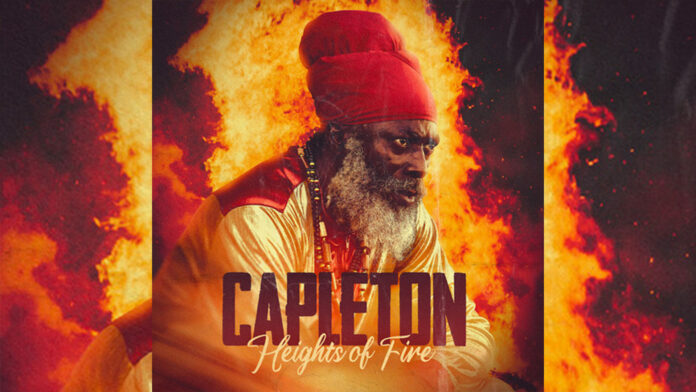

Capleton Heights of Fire – “The Fire Never Changes, Only the Level”
After sixteen years without a full studio album, reggae and dancehall icon Capleton has returned with Heights of Fire, a deeply spiritual project that reminds listeners why he remains one of Jamaica’s most respected cultural voices.
Speaking with Epik Jones for WORLMAG, the legendary artist reflected on patience, purpose, spirituality and why timing was more important than simply releasing another album.
“Patience Is a Virtue”
Asked why now was the right moment to release Heights of Fire, Capleton explained that great music cannot be rushed.
“Patience is a virtue. We have to give thanks for the people’s patience. Anybody can release albums back-to-back, but when the time is right, the work will reveal itself. Nothing happens before its time.”
For Capleton, the sixteen-year wait was never about absence. Throughout that period he continued releasing singles, performing worldwide and staying connected with his audience while allowing the complete body of work to mature naturally.
The Fire Has Never Changed
Although many artists evolve stylistically over time, Capleton insists the message remains exactly the same.
“It’s the same fire. It never changed. There are different levels of the fire, but it’s the same fire.”
He credits that fire to the cultural foundation laid by pioneers such as Peter Tosh, Jacob Miller and the elders who carried reggae’s message before him. Rather than seeing himself as something new, Capleton describes himself simply as a messenger.
“I’m just a reminder.”
More Soul. More Spirit.
When asked how Heights of Fire differs from previous albums, Capleton described the project in simple terms. “More soul. More spiritual connection. Higher vibration.” The album addresses social injustice, war, corruption and violence while delivering messages of hope, purpose and empowerment. According to Capleton, music should nourish the listener. “It’s food for the heart, soul and mind.”
Sixteen Years. Sixteen Tracks.
Epik Jones pointed out an interesting observation. Sixteen years had passed since Capleton’s previous studio album, and Heights of Fire arrives with sixteen tracks.
Although Capleton did not explicitly confirm the symbolism, he smiled at the observation before highlighting one song that currently represents him spiritually.
“Shine This Light.”
The record, he says, reflects his present mindset and spiritual journey.
Creative Challenges
Not every song comes together easily. When asked which record demanded the most creatively, Capleton immediately referenced “Babylon So Evil,” a powerful anthem that tackles corruption, oppression and resistance.
The track also features fellow reggae heavyweights Stephen Marley and Damian “Jr. Gong” Marley, a collaboration Capleton described as a natural progression built on years of mutual respect. “It’s a natural mystic.”
Supporting the Next Generation
The album also features younger talent, something Capleton believes is essential. He explained that giving emerging artists opportunities is part of preserving reggae’s future. “The youth are the future.”
Music Is a Mission
Throughout the interview, one message surfaced repeatedly. For Capleton, music has never been about fame, money or popularity. It is about service. “The people are everything. Without the people, we are nothing.” He rejected selfishness and reminded artists that music should uplift rather than simply entertain. As Epik Jones referenced one of Capleton’s famous philosophies: “Music is a mission, not a competition.” Capleton agreed wholeheartedly.
Spirituality Is the Key
One of the interview’s most powerful moments came when discussing spirituality. Capleton believes today’s world needs spiritual awareness more than ever. “Spirituality is the key to life.” He encouraged listeners to guard their thoughts carefully, believing positive thinking produces positive actions.
According to Capleton, every person faces a choice between good and evil every day, making personal responsibility central to one’s journey.
Fire Means Life
Asked what “fire” has symbolised throughout his career, Capleton offered perhaps the interview’s defining answer. “The fire is for the purification and preservation of souls.” For him, fire represents energy, culture, music, life and transformation. It is not destruction for destruction’s sake, but cleansing and renewal.
The UK’s Special Place
As a UK-based publication, WORLMAG asked about Capleton’s longstanding relationship with British audiences. The artist praised the UK for supporting his music throughout his career, referencing performances at City Splash and Reggae Land while thanking fans across London, Manchester, Huddersfield and beyond. He emphasised that reggae’s responsibility extends beyond entertainment. “Our music doesn’t just entertain. It educates.”
Quick Fire Round
Roots or Dancehall?
“Roots… because dancehall is a branch.”
One word to describe Heights of Fire?
“Spirituality.”
Which track should fans play first?
“Red Again.”
Which song means the most personally?
“Global War.”
Vinyl or Streaming?
“Vinyl can never die… but we’re living in the age of streaming.”
Complete the sentence: ‘The fire never…’
“Never quench. Never cool. Never dead.”
Final Thoughts
Closing the interview, Epik Jones encouraged reggae fans worldwide to support the project. Purchase the album. Buy the merchandise. Attend the tour. Support authentic reggae music. Capleton’s response was simple. “Blessings. Rastafari.” After sixteen years, Heights of Fire arrives not as a comeback, but as a continuation of a lifelong mission.
The fire, as Capleton says, has never changed.